Hope Harbor Movie Plot Explained: Na Hong-jin’s Cosmic Sci-Fi Epic Breakdown
There are movies that you watch, enjoy, and forget a week later. Then there are movies like Hope, the 2026 sci-fi horror epic from South Korean director Na Hong-jin, which practically demand that you sit down afterward and argue about what you just saw.
And honestly, I love that.
Na Hong-jin has never been interested in making comfortable movies. The Wailing proved that years ago, but Hope takes that same obsession with paranoia, dread, violence, and human desperation and throws it into something much bigger. What starts as a strange rural mystery near the Korean DMZ eventually turns into an alien invasion story on an absolutely ridiculous scale.
The funny thing is that the movie doesn’t feel ridiculous while you’re watching it.
It feels frighteningly grounded.
Hope Harbor Is the Perfect Place for a Nightmare
The film spends surprisingly little time explaining the outside world at first. Instead, Na Hong-jin traps us inside Hope Harbor with the residents.
The town is surrounded by mountains and forests, while wildfires begin spreading through the area. Communication systems go down, roads become increasingly difficult to use, and whatever connection Hope Harbor had with the outside world starts disappearing.
Nobody knows what’s happening.
That uncertainty becomes one of the movie’s strongest weapons.
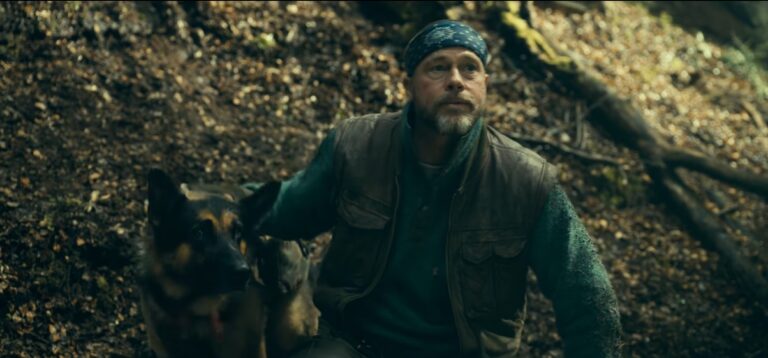
Police Chief Bum-seok, played by Hwang Jung-min, is suddenly forced to deal with a situation far beyond anything his small department was prepared for. His younger officer Sung-ae, played by Hoyeon, is thrown into the investigation as the mystery becomes increasingly violent.
Their first real clue is horrifyingly simple: a dead cow.
The animal has been torn apart by enormous claw marks, but nothing about the injuries makes sense. The damage doesn’t resemble a normal bear attack or anything else the locals recognize.
Naturally, the town assumes there’s a dangerous predator in the forest.
That assumption turns out to be spectacularly wrong.
The Hunters Quickly Become the Hunted
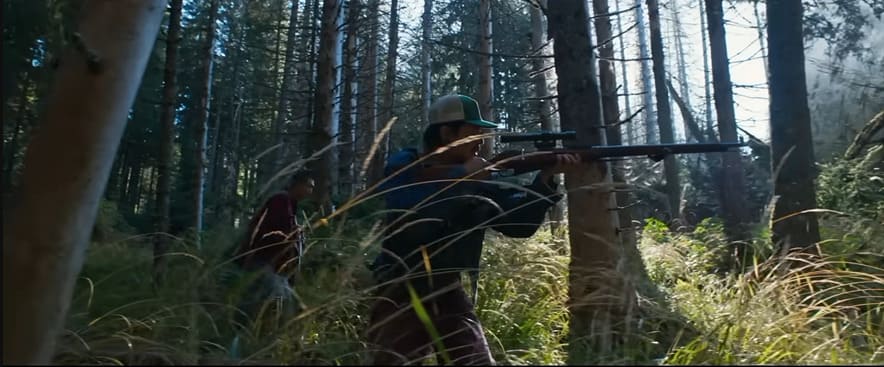
Zo In-sung’s Sung-ki enters the story as the kind of local tracker who seems convinced that every problem can be solved by going into the woods and finding whatever caused it.
It’s a classic monster-movie setup.
Get a group of armed men together. Follow the tracks. Find the creature. Kill it.
Except there is one enormous problem.
They can’t see what they’re hunting.
The expedition into the forest becomes one of the movie’s most effective sequences because Na Hong-jin refuses to show everything immediately. You hear movement. Trees break. Something seems to be nearby. The characters fire into empty darkness.
Then someone disappears.
Another person is attacked.
Suddenly, the hunting party understands that the rules have changed.
They aren’t tracking the creature anymore. The creature is tracking them.
That distinction gives the first half of Hope an almost old-school creature-feature energy. It’s less about explaining the monster and more about making you dread the moment when it finally appears.
The Alien Reveal Completely Changes the Movie
This is where Hope makes its biggest gamble.
If you walked into the theater expecting a grounded horror thriller, the revelation that follows is going to feel like someone changed the movie while you weren’t looking.
The thing attacking Hope Harbor isn’t a tiger, mutant animal, ghost, or Korean folk creature.
It’s extraterrestrial.
A gigantic spacecraft is revealed above the region, partially obscured by smoke and the chaos caused by the wildfires. The strange creatures moving through the town are part of an alien expedition originating from a distant world known as Gh’ertu.
And suddenly all those earlier scenes make more sense.
The strange wounds.
The disappearances.
The organized attacks.
The feeling that the enemy isn’t simply hunting for food.
These beings have arrived with a purpose.
That’s the point where Hope stops being a monster movie and becomes something much closer to a cosmic war film.
The Aliens Aren’t Just Cannon Fodder
This is probably my favorite decision in the entire movie.
Na Hong-jin could have made the extraterrestrials faceless CGI monsters that exist purely so the human characters have something to shoot at.
Instead, the movie gives them their own society, language, hierarchy, and motivations.
Michael Fassbender plays Ma’veyyo, one of the key figures among the alien forces, while Alicia Vikander portrays J’aur. Taylor Russell appears as Ai’dovor, another important member of the expedition, with Cameron Britton playing Va’migere.
Their presence changes the emotional equation.
These aren’t necessarily creatures that arrived on Earth simply because they wanted to destroy humanity. Their mission is connected to the collapse of their own world.
And that is where the title Hope becomes much more interesting.
What Does Hope Actually Mean?
For most of the movie, it’s easy to assume that ‘hope’ refers to the people of Hope Harbor.
They’re surrounded.
They’re isolated.
Their communications are gone.
The military isn’t coming to save them.
They have almost no chance against an enemy with technology they barely understand.
Yet they keep fighting.
But the final act suggests that the word has another meaning.
The aliens are desperate too.
Their home planet, Gh’ertu, is dying, and Earth appears to represent a possible future for their species. From their perspective, this invasion may not be about conquest in the traditional sense.
It could be survival.
And that’s a much nastier idea.
Because if the aliens genuinely believe Earth is their last chance, then humanity isn’t fighting an evil army.
We’re fighting another desperate civilization that thinks it has nowhere else to go.
That moral ambiguity is exactly the sort of thing I expect from Na Hong-jin.
The Final Battle Gets Completely Out of Control
By the time the story reaches its enormous final act, Hope Harbor barely resembles the sleepy settlement we saw at the beginning.
The locals are improvising everything.
Cars become weapons. Horses become transportation. Ordinary objects suddenly have survival value. Yang-bae, the eccentric carpenter played by Eum Moon-suk, helps create makeshift weapons from whatever the survivors can find.
There’s something strangely satisfying about watching these ordinary people refuse to simply run.
They know they’re outmatched.
They know the technology gap is absurd.
They fight anyway.
The movie’s roughly 160-minute runtime becomes particularly noticeable here because the final stretch is huge. Na Hong-jin isn’t interested in wrapping everything up neatly. Instead, he keeps expanding the scale until Hope Harbor feels like the first battlefield in something much larger.
And then the movie pulls the rug out again.
Hope Movie Ending Explained
The immediate conflict reaches a devastating conclusion, but the film deliberately refuses to give audiences the comfortable ending they might expect.
Hope Harbor survives only in the loosest possible sense.
The town has been destroyed, countless people are dead, and the alien presence has not been eliminated.
More importantly, the final scenes imply that what happened in this isolated Korean community wasn’t the main event.
It was the beginning.
The alien arrival appears to be part of a much larger operation, suggesting that other parts of the world may soon face the same threat.
That’s why the ending feels less like a traditional conclusion and more like the opening chapter of a much bigger story.
The implication of a trilogy makes sense, too. There’s simply too much left unexplained for the story to stop here.
What exactly happened to Gh’ertu?
How many alien ships are involved?
Does humanity know what’s coming?
And perhaps the biggest question: Are the aliens actually the villains?
The movie doesn’t give us a clean answer.
Thank God.
Why the DMZ Setting Matters
The location isn’t just there because it looks cool.
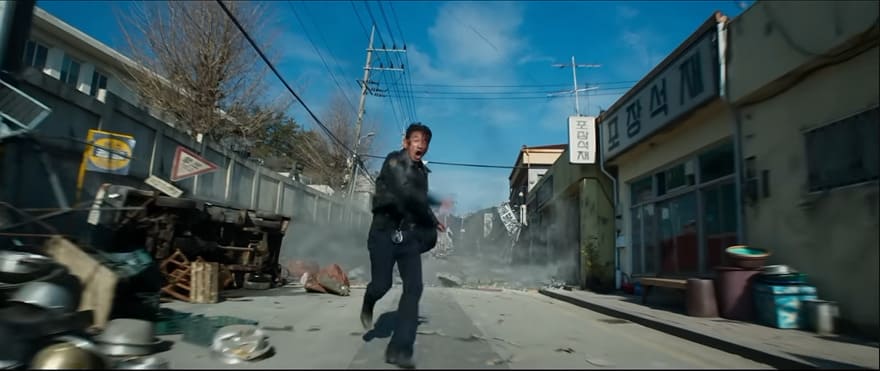
Putting an alien invasion next to the Korean DMZ adds another layer of tension to the story. The area is already defined by military suspicion, surveillance, borders, and the constant possibility of conflict.
Then something arrives that makes human borders completely meaningless.
Those ‘Report Spies’ warnings scattered around Hope Harbor suddenly feel almost darkly funny. The residents are worried about people crossing a political boundary while something from another planet is literally entering their world.
It’s a clever bit of irony.
Humanity has spent decades building barriers against itself, only to discover that those barriers mean absolutely nothing when the real threat comes from the sky.
The Cast Makes the Chaos Work
The international casting could easily have become a gimmick, but the performances help sell the bizarre premise.
| Character | Actor | Role in the Story |
|---|---|---|
| Bum-seok | Hwang Jung-min | Hope Harbor’s police chief and reluctant leader |
| Sung-ae | Hoyeon | Rookie officer caught in the escalating crisis |
| Sung-ki | Zo In-sung | Local tracker who becomes central to the fight |
| Ma’veyyo | Michael Fassbender | Major figure within the alien forces |
| J’aur | Alicia Vikander | Alien leader with her own agenda |
| Ai’dovor | Taylor Russell | Field operative involved in the invasion |
| Va’migere | Cameron Britton | Member of the extraterrestrial hierarchy |
| Yang-bae | Eum Moon-suk | Local carpenter who helps build improvised defenses |
Hwang Jung-min is particularly effective because Bum-seok never feels like a superhero. He’s tired, scared, confused, and still trying to protect people.
Hoyeon’s Sung-ae provides a different kind of energy. She doesn’t magically become an action icon overnight. Her determination feels like something growing out of panic and responsibility.
And Zo In-sung gets some of the film’s biggest physical moments.
The One Problem I Had With Hope
For all the things the movie gets right, it isn’t flawless.
The first half is incredible because the threat is mostly invisible. The tension comes from what you can’t see.
Once the film starts revealing more of the alien technology and throwing larger CGI sequences at the audience, some of that mystery disappears.
A few visual effects also don’t quite match the confidence of the practical-looking horror scenes earlier in the movie.
That’s not enough to ruin the experience, but the contrast is noticeable.
The irony is that Hope is often scarier when you barely understand what’s happening.
Give me a dark forest, distant screaming, broken communications, and something moving just outside the frame over a giant CGI creature smashing through buildings any day.
Why People Can’t Stop Talking About Hope
The film has practically been designed for post-movie arguments.
Reddit threads are full of theories about Gh’ertu. Viewers are picking apart background details. Others are trying to determine whether the aliens are invaders, refugees, or something much more complicated.
And I can already see this becoming one of those movies where the second viewing is arguably more interesting than the first.
Once you know the twist, the opening scenes can be interpreted differently.
The dead animals aren’t just setup for a monster attack.
The isolation isn’t just atmosphere.
The fires aren’t simply a disaster happening in the background.
Everything feels connected.
That’s the kind of genre filmmaking I personally find addictive.
Hope isn’t perfect, and I wouldn’t pretend every CGI-heavy action sequence lands with the same force as its quieter horror scenes. But the sheer ambition is difficult to ignore.
Na Hong-jin has taken a Korean rural thriller, a monster movie, an alien invasion, body horror, political tension, and a giant space-opera premise and somehow forced them into the same 160-minute film.
Somehow, it works.
And that final cliffhanger makes one thing painfully clear: Hope Harbor was never the whole story. It was only the place where humanity first realized that it wasn’t alone.