Hope 2026 Letterboxd Reviews: Is Na Hong-jin Sci-Fi Monster Epic a Masterpiece or a Diabolical CGI Mess?
There are movies you watch, think about for a few hours, and then move on. Hope (2026) does not seem interested in being one of those movies.
Na Hong-jin, the filmmaker behind The Chaser and The Wailing, has returned with something that feels almost deliberately designed to start arguments. Instead of another grim psychological thriller rooted in human paranoia, he has gone huge: alien creatures, a devastated coastal town, international stars, massive action sequences, dark comedy, and enough visual madness to make some viewers wonder whether they watched a finished movie or a very expensive fever dream.
And judging by the early reaction on Letterboxd, Reddit, and film-review channels, people absolutely cannot agree on what they’ve seen.
Some viewers are throwing around five-star ratings and calling Hope one of the craziest theatrical experiences of 2026. Others are furious about the effects, the enormous runtime, the messy second half, and an ending that apparently feels more like a promise of another movie than an actual conclusion. That split is what makes Hope so fascinating.
Spider-Man Brand New Day Post Credit Scene Explained: Cosmic Clues and Doomsday Connections
Na Hong-jin Goes From Psychological Horror to Full-Blown Sci-Fi Chaos
The basic setup sounds almost restrained compared with what follows.
The story takes place in Hope Harbor, an isolated South Korean coastal community cut off from the outside world after devastating wildfires. Communications are gone, the town is effectively trapped, and nobody really knows what is happening beyond the surrounding forests and coastline.
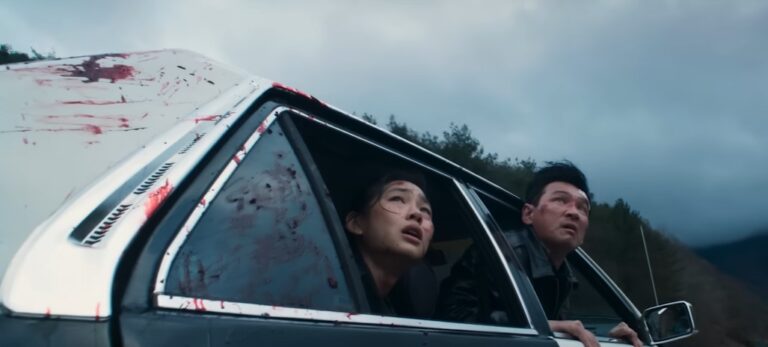
Hwang Jung-min plays Bum-seok, a hardened police chief who has seen enough ugly situations to know that panic can be more dangerous than almost anything else. Hoyeon plays Sung-ae, a rookie deputy thrown into a situation that rapidly gets far beyond her experience. Then hunters led by Sung-ki, played by Zo In-sung, discover mutilated livestock. At first, this looks like a familiar monster-investigation setup. Maybe there’s a wild animal nearby. Maybe something escaped. Maybe people are exaggerating what they saw.
Then the evidence gets considerably harder to explain. The creatures aren’t behaving like anything that belongs in this ecosystem. Their attacks are brutal, their movements are strange, and the more the characters investigate, the less comfortable the idea of a normal explanation becomes. That’s where Na Hong-jin starts pushing the movie into much stranger territory.
With Michael Fassbender, Alicia Vikander, Taylor Russell, Cameron Britton and a major Korean cast involved, Hope has the scale of an international blockbuster while still carrying some of the grimy humor and uncomfortable human behavior associated with Na’s earlier work.
That combination is either the movie’s greatest strength or its biggest problem.

The First Hour Is Absolutely Ridiculous — In the Best Possible Way
If there is one part of Hope that seems to have created almost universal excitement, it’s the opening stretch. The movie wastes very little time. Rather than spending forever explaining the mythology behind the creatures, Na Hong-jin throws the audience into a town that already feels like it’s coming apart. Bodies appear. Animals are slaughtered. Strange structures are discovered. People start making terrible decisions.
And then everything accelerates.
The filmmaking during this section sounds like pure adrenaline. Police vehicles tear through roads, horses panic, people race through forests, and characters find themselves fighting something they don’t understand. The camera rarely gives the audience enough information to feel safe.
That’s where the movie reportedly hits its strongest note. The tension works because the monster remains a problem before it becomes a character. You don’t fully understand what you’re looking at, and that uncertainty makes every strange noise or movement more threatening. It’s the same basic trick that made Jaws and Alien so effective: fear gets stronger when the audience’s imagination is doing some of the work.
There are also moments of absurd Korean dark comedy that cut through the terror. Hwang Jung-min apparently gets plenty of opportunities to be angry, vulgar, exhausted and hilarious at the same time, while Hoyeon’s performance gives the action a different kind of energy. Some early audience reactions have compared the film’s first half to a collision between Alien, Jaws and Mad Max: Fury Road. That’s an insane combination. It’s also exactly the kind of comparison that makes me want to see what the hell Na was thinking when he made this.
Hoyeon and Hwang Jung-min Give the Chaos Some Personality
The danger with a movie this large is that characters can quickly become disposable.
Hope occasionally seems to flirt with that problem, but the central performances reportedly keep the human side of the story alive.
Hwang Jung-min is particularly well suited to this kind of role. Bum-seok isn’t a clean-cut action hero. He’s tired, cynical and increasingly desperate as the situation deteriorates. That makes his reactions feel more entertaining than the usual blockbuster character who somehow remains perfectly calm while an alien monster destroys everything around him.
Hoyeon’s Sung-ae provides another interesting contrast.
She’s inexperienced, but the movie doesn’t apparently treat that as an excuse to make her helpless. As the crisis escalates, she becomes increasingly involved in the fight, and some of the film’s most crowd-pleasing moments reportedly come from watching her go from rookie deputy to someone willing to get extremely violent. The international cast is another strange ingredient.
Michael Fassbender and Alicia Vikander bring obvious prestige, but Hope doesn’t appear interested in turning itself into a conventional Hollywood sci-fi drama. The Korean setting, humor and social tension remain important even when the movie starts throwing increasingly enormous action sequences at the audience.
That makes the whole thing feel slightly unstable.
And I mean that as a compliment.
Then the Movie Gets Very, Very Long
Here’s where the Letterboxd arguments really start. Hope runs for roughly 2 hours and 40 minutes, and the movie apparently changes personality somewhere around the halfway point. The first half is built around mystery, confinement and escalating fear. The second becomes much more expansive and action-heavy. For some viewers, that’s exactly what they wanted. For others, it’s where the movie loses its grip.
Once the creatures become more visible and the characters spend less time trying to understand the mystery, the suspense starts giving way to constant pursuit. Cars race. People run. Monsters attack. Characters scream. Then somebody runs again. That can be exhilarating for a while. After nearly three hours, though, repetition becomes a serious issue. A recurring criticism from viewers is that the enormous cast doesn’t always get enough material to justify its size. Characters who initially seem important can disappear for long stretches, while others exist primarily to participate in the next action scene.
There’s a fascinating movie buried inside this setup about isolation, fear, human stupidity and our instinct to invent explanations when faced with something incomprehensible. Then Hope sometimes seems to look at that movie and say, “”Forget it. Let’s make the horses run.”” Honestly, I can respect the impulse. But I can also understand why some viewers came away frustrated.
The CGI Is the Biggest Problem
This is probably the most damaging criticism surrounding Hope 2026. The movie reportedly has enormous ambitions when it comes to its creatures, but not every digital effect lands. Some audience members have described the CGI as rough enough to pull them directly out of the movie. The problem isn’t simply that the monsters don’t look photorealistic. It’s that their movement can apparently feel disconnected from the physical world around them.
That matters enormously in a creature movie.
A monster can look strange. It can look artificial. It can even look deliberately stylized. But when its movement doesn’t appear to obey the same physical rules as the actors, horses, vehicles and environments, the illusion starts falling apart. And Hope apparently gives its creatures plenty of screen time. That’s a risky choice. Keeping the monster partially hidden can make a modest effect terrifying. Showing it constantly means the audience gets plenty of opportunities to inspect every awkward frame.
This is especially frustrating because the production has so much going for it visually. With cinematographer Hong Kyung-pyo involved, the film has the pedigree to look spectacular. The production design, atmosphere and large-scale environments reportedly work extremely well.
Then a creature appears and suddenly you’re thinking about CGI instead of survival.
That’s not ideal.

Why Some Viewers Still Love It
Here’s the thing: I completely understand the five-star reactions. There is something refreshing about a filmmaker with an established reputation deciding to make a gigantic, weird, expensive genre movie instead of repeating himself. Na Hong-jin could have made another bleak crime thriller. Instead, he made an alien monster movie. And apparently he made it with absolutely no interest in behaving like a normal alien monster movie.
The result sounds messy, excessive and occasionally ridiculous, but also genuinely alive.There are plenty of technically polished blockbusters that feel like they’re assembled by committee. Hope doesn’t sound like one of them. Even its problems seem connected to ambition. The movie takes big swings. Some of those swings apparently miss. A few of them might hit you directly in the face. That’s still more interesting to me than watching another perfectly competent franchise product that nobody will remember six months later.
Why Other Viewers Are Furious
The complaints aren’t difficult to understand either. If you went into Hope expecting another tightly controlled psychological nightmare from the director of The Wailing, this could be a brutal adjustment. The story reportedly leaves major questions unanswered, the pacing becomes increasingly aggressive, and the ending appears designed to keep the door open for more. That’s a dangerous move.
An ambiguous ending can be fantastic when it deepens the movie you’ve just watched. It can also feel incredibly annoying when you’re sitting there thinking, “”Wait… that’s it?””The suggestion that Hope could be the beginning of a larger franchise only makes that reaction stronger. Nobody wants to feel like they watched Part One of a story that wasn’t finished yet. At least, not unless Part One feels satisfying on its own.
The Biggest Complaints From Mixed Reviews Include:
- The 160-minute runtime starts to feel excessive.
- The second half reportedly sacrifices mystery for relentless action.
- Some characters receive surprisingly little development.
- The creature CGI can look unfinished or inconsistent.
- Several story elements appear deliberately unresolved.
- The ending may frustrate anyone expecting a complete standalone narrative.
Hope (2026) at a Glance
| Element | What to Expect |
|---|---|
| Director | Na Hong-jin |
| Genre | Sci-Fi, Horror, Thriller |
| Runtime | Around 2 hours 40 minutes |
| Setting | Isolated South Korean coastal town |
| Main Cast | Hwang Jung-min, Hoyeon, Zo In-sung, Michael Fassbender, Alicia Vikander |
| Biggest Strength | First-half tension and action |
| Biggest Weakness | Uneven pacing and CGI |
| US Release | September 9, 2026 |
| Distributor | NEON |
So, Is Hope Actually Good?
I think the most interesting thing about the early Hope Letterboxd reviews isn’t that they’re divided.
It’s why they’re divided.
This isn’t a case where half the audience thinks the movie is boring and the other half thinks it’s entertaining. The disagreement seems to come from the movie constantly changing what kind of experience it wants to be. For one stretch, you’re watching a tense Korean horror movie. Then you’re watching a creature feature.
Then it’s basically an action blockbuster. Then somebody delivers a filthy joke. Then the film throws another enormous monster sequence at you. Then you’re left staring at the credits wondering whether you’ve just watched the ending or the setup for another movie. That’s chaotic filmmaking. But it’s also unmistakably Na Hong-jin.
I would much rather watch a strange, overstuffed movie that takes ridiculous risks than a safe sci-fi film that never surprises me. The CGI issues and bloated second half could absolutely test my patience, though, especially if the ending really does function primarily as a franchise setup.
Still, the first-hour praise has me paying attention.
If Hope can deliver even half of the theatrical insanity people are describing, this could become one of those movies audiences argue about for years. Maybe it’ll be remembered as an ambitious masterpiece that got unfairly punished for its rough edges. Or maybe we’ll look back at it as a spectacularly expensive mess with some killer action scenes trapped inside a movie that desperately needed another edit. Either way, Hope is clearly not boring. And honestly, that’s probably the best reason to see it in a theater when it reaches North America on September 9.
Bring an open mind.
And maybe don’t expect The Wailing 2.