Dark Matter Season 2: The Box Gateway to Other Realities Explained
Dark Matter Season 2 has already done something I honestly did not expect: it has made the Box itself feel more frightening than the alternate versions of Jason Dessen.
When the first season of Apple’s mind-bending sci-fi thriller introduced the Box, it was easy to think of it as a very complicated plot device. A machine that could send someone into another reality, an impossible corridor filled with doors, and an endless collection of alternate lives. That was already a fascinating idea, but Season 2 pushes the concept much further.
Based on Blake Crouch’s novel and developed for television with Crouch himself deeply involved, Dark Matter Season 2 expands beyond the story audiences originally knew. Jason Dessen, Daniela, and Charlie are no longer simply trying to escape Jason 2. They are dealing with a much bigger problem: the multiverse may not have a safe place to hide.
And that changes the meaning of the Box completely.
The Box Isn’t Really a Portal
One of the things I love about Dark Matter is that the Box never feels like a conventional science-fiction portal. You don’t simply walk through a glowing doorway and choose a planet from a menu. The mechanism is tied to quantum superposition, human consciousness, and the psychological state of the person using it.
The basic idea is deceptively simple. The Box isolates the person inside from the outside environment, allowing them to exist in a state of quantum uncertainty. Once the traveler enters the corridor, countless possible realities are represented by the doors surrounding them.

Every door looks almost identical. That’s what makes the whole thing so unsettling.
There is no giant sign saying “Reality Where Jason Has a Perfect Life.” There is no GPS. There is no reliable map. The traveler has to navigate using their own mind, memories, emotions, and intentions.
That makes the Box much more personal than a traditional multiverse machine. You aren’t simply traveling through space. In a strange way, you are traveling through your own possibilities.
Why the Drug Is Essential for Multiverse Travel
The human brain creates another major problem. If consciousness is itself an act of observation, then entering a state of quantum superposition becomes incredibly difficult. A normal person cannot simply switch off their perception of reality.
That’s where the neural compound comes in.
Fans have often referred to it as the “lavender wings” drug, and its purpose is essentially to prevent the traveler’s consciousness from collapsing the superposition too quickly. Without it, the entire process would be practically impossible.
But the drug doesn’t magically turn the Box into a multiverse navigation system. The traveler still has to control their thoughts.
This is probably one of the most interesting details in the entire mythology. If you’re terrified, desperate, angry, or obsessing over a particular possibility, those emotions can influence where you end up. The corridor isn’t responding to a computer command. It’s responding to the person walking through it.
That means Jason’s greatest weakness isn’t necessarily another Jason.
It may be Jason himself.
Season 2’s Box Twist Changes Everything
The first episode of Season 2, A Quiet Life, introduces what might be the biggest change to our understanding of the Box.
Amanda Lucas and Ryan Holder have established themselves in a seemingly ideal version of Chicago. They have a life that feels almost too good to be true, which, in Dark Matter, is usually a warning sign.
When they return to the Box, something is wrong.
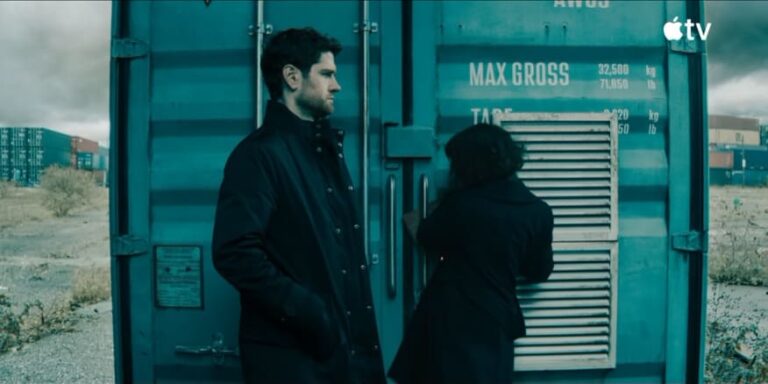
The structure has been moved, and the connection to the corridor appears to be gone. Instead of opening into the strange gray passage between realities, the door simply leads into an ordinary concrete space.
At first, this seems like fantastic news. If the Box can be disconnected, perhaps a reality can actually protect itself from unwanted visitors.
Then the show pulls the rug out.
The Box Can Come Back
Jason 1, Daniela, and Charlie eventually arrive in that same reality, but they don’t use the relocated Box.
They emerge from another Box.
And this is where Season 2 becomes genuinely creepy.

The implication is that moving the physical structure doesn’t necessarily eliminate the gateway. The multiverse seems to retain a connection to the Box’s original location. If a traveler reaches that reality through the corridor, another Box can manifest at the relevant coordinates.
Personally, I think this is a much better twist than simply revealing another villain. A new Jason would be dangerous, but a system that essentially refuses to stay shut is much harder to defeat.
You can’t negotiate with it. You can’t scare it away. You can’t convince it to stop.
It’s a mechanism built around infinite possibility.
Why Destroying the Box May Not Solve Anything
This also creates a huge problem for Jason and his family.
Imagine finally finding a reality where you can disappear. You destroy the Box, bury the remains, move away from the original location, and convince yourself that you’ve finally escaped the multiverse.
Then another version of the Box appears.
That’s an absolutely brutal concept because it takes away the simplest solution to the family’s problem. In most science-fiction stories, destroying the machine closes the portal. Dark Matter suggests that the machine may be less important than the underlying connection itself.
The Box starts to feel less like an invention and more like a permanent scar across reality.
Leighton Vance’s Original Dream Wasn’t So Sinister
Season 2 also gives us a better look at Leighton Vance and the original purpose behind the project at Velocity Labs.
That backstory adds an unexpected layer to the character.
Leighton didn’t necessarily begin with the goal of becoming a multiverse-obsessed billionaire playing god. His original vision was much more ambitious and, on the surface, surprisingly noble.
What if another version of Earth had solved problems that our world couldn’t?
What if another civilization had eliminated major diseases? What if they had solved climate problems, created revolutionary technologies, or found ways to prevent wars?
The Box could theoretically allow researchers to find those answers.
It sounds almost utopian.
But then reality intervened.
People disappeared. Test subjects became trapped. Jason 2 vanished. Blair Caplan and other pilots were lost. The project became increasingly secretive and dangerous. The more Leighton learned about the multiverse, the harder it became to control.
That history makes his transformation much more tragic. The Box wasn’t necessarily created as a weapon. It was created because someone believed infinite possibilities could give humanity a better future.
Instead, it exposed how badly humans handle infinite choices.
Why You Probably Won’t Find a Dinosaur Reality
One question fans naturally ask is why the corridor doesn’t seem to lead to absolutely anything imaginable.
Where are the worlds ruled by dinosaurs? Where are the completely alien civilizations? Where are the realities where humanity never evolved?
The answer comes down to the relationship between the traveler and the destination.
The Box isn’t simply opening random doors across an unlimited collection of universes. The traveler has to have some kind of connection to the reality they’re trying to reach. Human consciousness, possible choices, personal history, and alternate versions of existence all matter.
That’s why the multiverse of Dark Matter feels surprisingly intimate despite being infinite.
There may be countless realities, but they are largely variations on human possibility.
And honestly, I think that’s far more interesting than throwing random alien planets into the story.
The Low-Tech Chicago Reality Is a Clever Escape Plan
Jason, Daniela, and Charlie eventually realize that finding a beautiful reality isn’t enough. They need somewhere where nobody knows them.
That distinction is crucial.
A wealthy alternate Chicago might look perfect, but if another version of Jason has already been there, it becomes dangerous. If modern surveillance exists, the family could be tracked. Facial recognition, digital records, smartphones, cameras, databases, and the internet all become potential threats.
That’s why a low-tech version of Chicago becomes such an appealing destination.
It may not be glamorous, but it offers something the family desperately needs: anonymity.
In a world without the same level of interconnected technology, disappearing becomes considerably easier. Jason, Daniela, and Charlie can attempt to build a new life without leaving a massive digital footprint behind them.
There is a delicious irony here. Jason has access to technology capable of crossing realities, yet his best hiding place might be a world where people don’t have modern computers and smartphones.
But the Multiverse Keeps Pulling Them Back Together
Of course, Dark Matter doesn’t allow the family to relax for long.
Amanda and Ryan are also moving through the Box, and their paths eventually intersect with the Dessens again. At one point, they even end up in the same hotel in the same reality.
That coincidence is exactly why the Box is becoming more frightening with every episode.
The characters aren’t choosing from a clean list of independent universes. Their choices overlap. Their memories overlap. Their possibilities overlap.
Even when Jason thinks he’s found a completely separate life, another thread of the multiverse can pull someone else directly into it.
| Box Rule | What It Means for Jason’s Family |
|---|---|
| Travel depends on consciousness | Fear and emotion can affect where travelers end up. |
| The Box can lose its connection | Moving the structure may temporarily disconnect it from the corridor. |
| A new Box can appear | Destroying or relocating one gateway may not permanently protect a reality. |
| Realities are connected to personal possibility | The multiverse is shaped around human choices rather than completely random worlds. |
| Multiple travelers can reach the same reality | Running to another universe doesn’t guarantee that someone else won’t follow. |
The Box Has Become the Real Villain
What makes Season 2 work for me is that the show is gradually changing the question.
Season 1 asked: Which Jason deserves to live this life?
Season 2 is asking something much more uncomfortable: What happens when you have infinite opportunities to run away?
The Box represents every possible escape. If your life isn’t working, choose another reality. If someone is chasing you, choose another door. If you made a terrible decision, find the version of yourself who made a better one.
Sounds perfect, right?
Except there is no guarantee that the next reality is safer. There is no guarantee that you won’t encounter another version of yourself. There is no guarantee that someone else won’t follow you. And there is certainly no guarantee that you can keep running forever without losing something along the way.
That’s where Dark Matter Season 2 becomes more than a puzzle-box science-fiction thriller. The multiverse is basically an exaggerated version of something painfully human: the temptation to believe that somewhere else, another choice would have fixed everything.
Jason’s problem isn’t that he has too few options.
His problem is that he has infinitely many.
How Many Episodes in The Paper Season 2? Release Date, Cast, and Peacock Streaming Guide
What the Box Means for the Rest of Season 2
If the new rules hold, Jason and his family can’t simply locate the perfect universe and settle down forever. Every reality remains potentially connected to the same multiversal system, and every trip through the corridor creates another opportunity for their paths to cross with alternate versions of themselves.
That makes the Box the perfect symbol for the entire series. It offers freedom while simultaneously creating another kind of prison.
And that’s probably why I find the Season 2 direction so compelling. The biggest threat isn’t necessarily a monster, a corporation, or even Jason 2 anymore. It’s the belief that there must be a better version of your life somewhere behind another door.
Maybe there is.
But if Jason keeps opening doors, he may eventually discover that the safest reality isn’t the one where everything went right.
It might simply be the one where he finally decides to stop looking.
Final Thoughts
Dark Matter Season 2 is taking the Box from an impressive piece of sci-fi technology and turning it into something much more unsettling. Its rules are becoming stranger, its consequences more permanent, and its relationship with human consciousness more important.
The relocated Box, the appearance of new gateways, the low-tech Chicago reality, Amanda and Ryan’s continued journey, and the history of Velocity Labs all point toward the same idea: there may be no easy way to escape the multiverse once you’ve learned how to enter it.
And that’s exactly the kind of sci-fi I want from Dark Matter. Not just explosions and alternate versions of the same character, but uncomfortable questions about identity, regret, choice, and whether having infinite possibilities actually makes us happier.
The Box gives Jason access to endless realities.
The real question is whether he can find the courage to choose just one.