Hope (2026) Alien Threat Invasion Explained: Na Hong-jin’s Mind-Bending Sci-Fi Masterpiece Deconstructed
There is a moment in Hope when you realize Na Hong-jin has no intention of giving you the movie you thought you were watching. That is either thrilling or infuriating, depending on how much patience you have for a director deliberately pulling the floor out from under his audience.
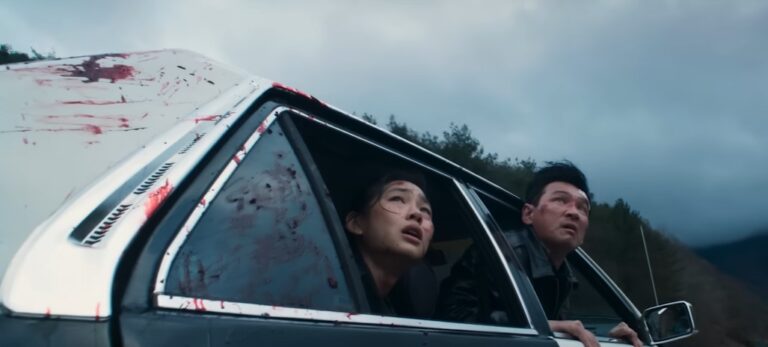
The film begins like a grimy Korean rural thriller. A dead animal. A strange set of wounds. A nervous police chief. Hunters wandering around an isolated community. Something is clearly wrong, but nobody can quite explain what. It feels close to The Wailing in spirit, with that same creeping suspicion that reality is about to become much stranger than the characters realize.
Then Hope stops playing fair.
What begins as a small-town monster story eventually becomes an enormous science-fiction conflict involving an extraterrestrial civilization, a gigantic spacecraft, human paranoia, and a species from a distant world called Gh’ertu. The shift is deliberately outrageous. Personally, I loved the nerve behind it, even when I thought the film was pushing its luck.
Na Hong-jin has made something messy, excessive and occasionally brilliant. And yes, Hope is absolutely too much movie. But I’d rather watch a filmmaker swing wildly for something memorable than spend two and a half hours watching another polished studio product afraid of making anyone uncomfortable.
From a Dead Bull to an Alien War
The setup is deceptively simple. In the isolated coastal community of Hope Harbor, local hunters discover the mutilated body of a large male bovine. The wounds are bizarre enough to immediately raise questions. This is not a normal predator attack, and the more the locals investigate, the less sense the evidence makes.
Police chief Bum-seok, played by Hwang Jung-min, is dragged into the investigation alongside rookie officer Sung-ae, portrayed by Hoyeon. Their initial reactions are exactly what you would expect from people who have absolutely no reason to believe aliens are about to become their problem.
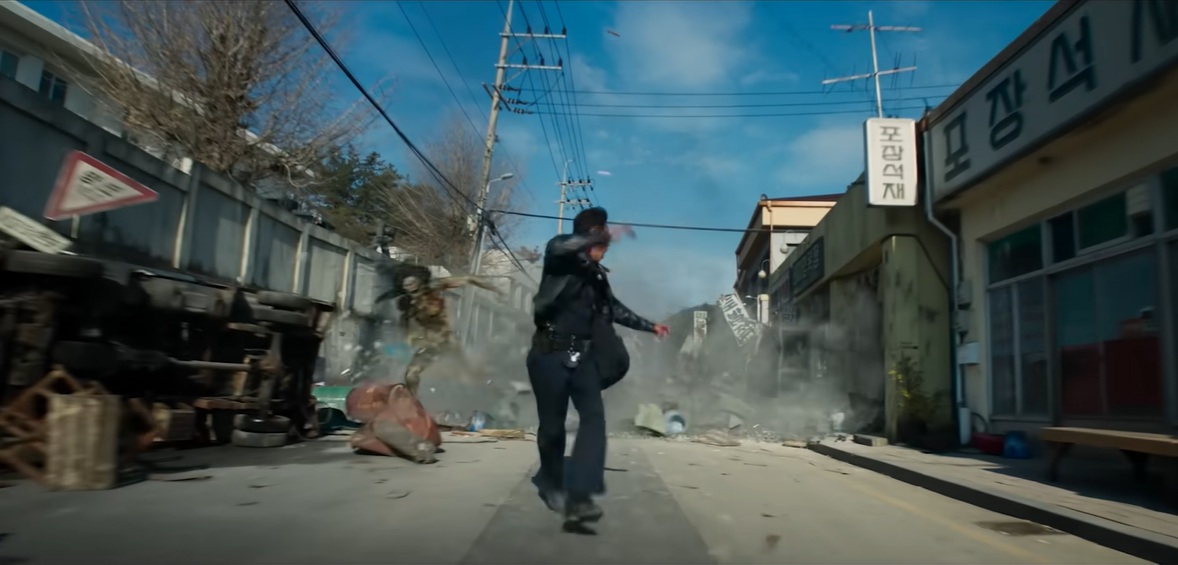
A local hunter named Sung-ki, played by Zo In-sung, provides some of the film’s stranger comic energy. Even the possibility of a tiger wandering over from North Korea gets tossed around before the situation becomes considerably more ridiculous.
And that is one of the things I appreciate about the movie. The characters do not behave as if they know they’re inside a science-fiction epic. They behave like ordinary people confronted with something they cannot identify.
That makes the escalation hit harder.
The surrounding mountains erupt into chaos as wildfires spread. Communications collapse. Military resources are diverted elsewhere. Hope Harbor effectively becomes a sealed-off pocket of civilization. The villagers cannot simply call for help and wait for the cavalry to arrive.
They are on their own.
Then the creature attacks.
What follows is where Hope starts tearing apart its own genre boundaries. The monster is initially presented as an animalistic threat, something terrifyingly physical and difficult to understand. But eventually the film reveals that this is only one piece of a much larger extraterrestrial presence.
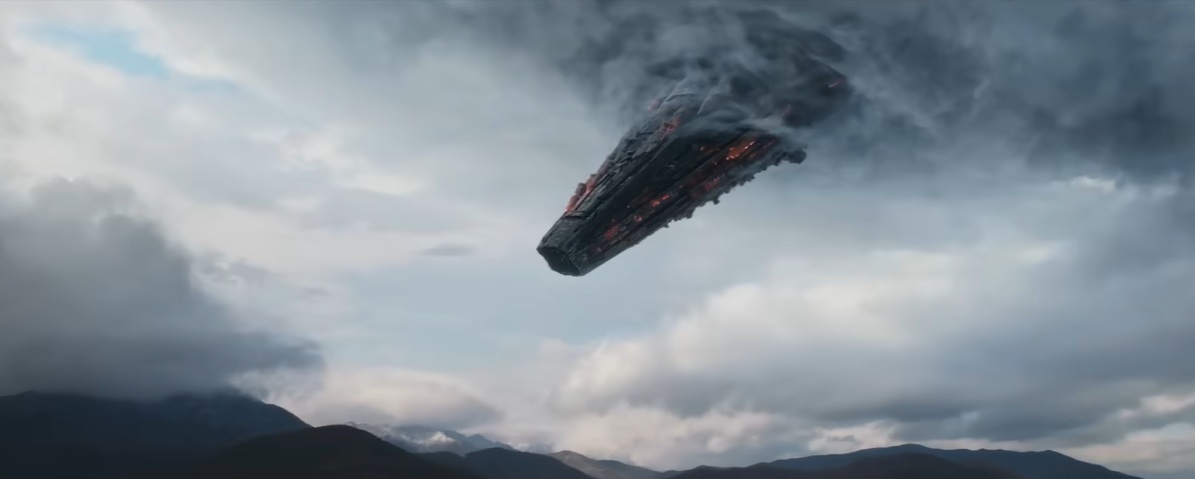
And then that spaceship appears.
At that point, the movie has officially gone from “What killed the animal?” to “Why is an alien civilization here?”
Who Are the Gh’ertu Aliens?
The aliens are arguably the most interesting—and most divisive—part of Hope.
Na Hong-jin could have made them standard invasion-movie monsters. Instead, he gives them personalities, motivations and a social structure of their own. Their homeworld, Gh’ertu, is not simply a convenient name attached to a villainous species. The film gradually suggests that these beings have their own fears, loyalties and reasons for doing what they do.
This changes the entire interpretation of the invasion.
Humanity is not simply fighting an army of evil creatures. The aliens are reacting to their own circumstances, just as the humans are reacting to theirs. Neither side possesses the complete picture, and that lack of information becomes the engine driving the catastrophe.
The international casting makes the shift even more noticeable. Michael Fassbender, Alicia Vikander, Taylor Russell and Cameron Britton are connected to the alien characters through voice, performance and motion-capture work, giving the extraterrestrial side of the story a strangely recognizable emotional presence.
I have mixed feelings about this decision. When it works, it makes the film feel much larger than the Korean village where the story begins. When it doesn’t, the visual effects can feel less convincing than the grounded practical tension of the opening act.
That’s the gamble Hope makes. Sometimes it pays off spectacularly. Sometimes you can practically see the machinery underneath the spectacle.
Why Set an Alien Invasion in an 1980s Korean Border Community?
This is where the movie becomes considerably more interesting than its monster-movie premise suggests.
Hope Harbor exists in a world shaped by division. The village’s proximity to the DMZ means its residents have already been taught to think about invasion, spies and military threats. Suspicion is part of everyday life.
And then the real invaders arrive from somewhere nobody was prepared to imagine.
The 1980s setting is crucial. There are no smartphones. No instant internet searches. No social media videos uploaded seconds after something horrifying happens. Information moves slowly, and communication depends on vulnerable physical infrastructure.
That makes the isolation almost cruel.
The villagers cannot Google the creature. They cannot check satellite imagery. They cannot livestream the invasion to the rest of the world. Their understanding of events is built almost entirely from what they can see with their own eyes.
And human beings are spectacularly bad at interpreting things they don’t understand.
The movie’s central idea is brutally simple: fear fills gaps in knowledge.
The villagers already live with a culture of suspicion because of decades of geopolitical tension. When something genuinely alien appears, they interpret it through the only framework they have. Threat. Enemy. Attack.
The aliens make the same mistake from their side.
Neither species has enough information to understand the other, and every violent response produces another violent response.
The Alien Invasion Is Really a Story About Misunderstanding
This is where I think Hope is at its strongest.
The film’s aliens are frightening, but the deeper horror is not necessarily their physical power. It is the possibility that both sides could have behaved differently if they had understood what the other wanted.
There is something almost painfully familiar about that idea. Humanity spends the entire movie expecting the worst because expecting the worst feels safer. The aliens are treated as monsters before anyone has the ability—or willingness—to understand them.
Of course, the movie doesn’t turn this into a tidy anti-violence lecture. Thank God.
People panic. People make stupid decisions. People shoot first. People protect their families. People misunderstand what they see. Some characters act bravely; others make decisions that are downright reckless.
That’s much more convincing than having everyone suddenly become perfectly rational representatives of humanity.
Hope (2026) Ending Explained
The ending refuses to give the audience the comfortable victory expected from a conventional alien invasion movie.
By the final act, Hope Harbor has been devastated. The alien presence has transformed the isolated community into a battlefield, while Bum-seok, Sung-ae and Sung-ki struggle to survive amid escalating violence.
The massive spacecraft hanging over the landscape is almost absurdly imposing. Yet the real weight of the finale comes from what it represents. Humanity has encountered an intelligence from beyond Earth, and instead of achieving some miraculous moment of understanding, both sides descend into destruction.
There is no clean heroic triumph.
There is no satisfying explanation that suddenly makes every death meaningful.
There is simply the wreckage left behind after fear has been allowed to dictate every decision.
The recurring idea that perception can be misleading becomes especially important here. The humans see monsters. The aliens see threats. Each side acts on incomplete information, and each reaction makes peaceful contact less likely.
That makes the title Hope almost cruelly ironic.
The village itself is called Hope, yet the place is consumed by violence. The word that should suggest optimism becomes a reminder of everything the characters failed to preserve.
Still, the ending is not completely nihilistic. Some characters survive, and the emotional complexity given to the alien side leaves open the possibility that the conflict is not necessarily the end of the story.
Survival remains possible.
Understanding might be possible too.
But the movie clearly doesn’t believe either comes easily.
What Works—and What Doesn’t
| Element | My Take |
|---|---|
| Atmosphere | Excellent. The rural setting feels increasingly claustrophobic as the situation deteriorates. |
| Action | Wild, physical and frequently chaotic. Some sequences are genuinely spectacular. |
| Alien Concept | Ambitious and far more interesting than a basic invasion narrative. |
| Visual Effects | Uneven. The best shots are impressive, but some CGI-heavy moments lack the tactile quality of the opening. |
| Pacing | Risky. The tonal shifts are fascinating, but the long runtime will test some viewers. |
| Performances | Hwang Jung-min anchors the human side, while the international alien cast gives the second half unexpected dramatic weight. |
Why the Movie Has Divided Audiences
I’m not surprised that Hope has produced such wildly different reactions.
If you want a straightforward monster movie, this film is going to frustrate you. If you want a conventional alien invasion blockbuster, it may frustrate you even more. Na Hong-jin keeps changing the rules, sometimes just when you’ve become comfortable with them.
The first section has the tension of a rural horror thriller. Then the movie becomes an action picture. Then science fiction takes over. Dark comedy appears in places where you probably aren’t expecting it. The alien characters eventually demand serious emotional attention.
It’s a lot.
The reported 160-minute runtime doesn’t exactly help. Some sequences feel deliberately prolonged, and I suspect a tighter edit would have made the film considerably more effective without sacrificing its ambition.
Still, I would take this over something safer.
There are films that are technically competent and instantly forgettable. Hope is not one of them. Even when I found myself questioning a creative choice, I was still curious about what Na Hong-jin would do next.
Hope 2026 Ending Explained: Cosmic Horror, Alien Lore, and That Wild Twist Revealed
Is Hope the Start of a New Sci-Fi Franchise?
Apparently, Na Hong-jin isn’t finished with this world.
Hope has been positioned as the beginning of a planned trilogy, with a sequel reportedly already confirmed and a script in development. If that plan survives, the first movie’s deliberately limited perspective could eventually expand into something much bigger.
That opens up some genuinely interesting possibilities.
- Gh’ertu could become a much more important part of the mythology.
- The consequences of first contact could spread far beyond Hope Harbor.
- The alien characters could receive significantly more development.
- The conflict could evolve from survival horror into full-scale cosmic science fiction.
The biggest question is whether the sequels can preserve the weirdness that makes the first film memorable. If everything becomes bigger, louder and more expensive, the series could lose the uncomfortable intimacy that makes the opening of Hope so effective.
My Verdict on Hope (2026)
Hope is ambitious to a borderline unreasonable degree. It is strange, violent, funny, bleak and occasionally magnificent. It also feels overstuffed, and there are moments when the movie seems almost too eager to prove how much it can contain.
But I can’t really hold that against it.
Na Hong-jin has made the kind of science-fiction film that refuses to behave like a conventional science-fiction film. Instead of giving us another anonymous alien army and a collection of disposable human heroes, he builds the conflict around fear, perception and the catastrophic consequences of not understanding what stands in front of you.
The alien invasion is the spectacle. The misunderstanding is the actual horror.
And that’s why Hope sticks in the mind after the chaos settles. Beneath the spaceships, creatures and gunfire is a much uglier question: what happens when two civilizations meet and both are convinced the other one is the monster?
Na Hong-jin doesn’t offer an easy answer. Honestly, I’m glad he doesn’t.
My rating: 8/10.
It’s not flawless, and the enormous runtime plus uneven effects occasionally drag it down. But for sheer audacity, atmosphere and willingness to take a ridiculous premise somewhere genuinely uncomfortable, Hope deserves credit. Love it or hate it, this is not the sort of alien invasion movie you’re likely to forget five minutes after leaving the theater.