Is Blood Sacrifice Available in 4K HDR on Netflix? Stream Quality Guide
If you’re the kind of viewer who notices picture quality, Blood Sacrifice (Blodsoffer) is exactly the sort of series that makes the Netflix Premium question worth asking. This five-part Swedish crime thriller arrived on Netflix on August 20, 2026, and it has a visual identity that feels very different from the usual cold, gray Nordic noir formula.
The answer is straightforward: yes, Blood Sacrifice is available in 4K Ultra HD with HDR, including Dolby Vision support, on Netflix. But there’s a catch that can make the difference between watching the series as intended and simply watching another 1080p stream. You need the right Netflix plan, compatible hardware, and a fast enough internet connection.
And honestly, I think this is one of those shows where the upgrade makes more sense than it might initially sound.
Is Blood Sacrifice Available in 4K HDR on Netflix?
Yes. Blood Sacrifice streams in 4K Ultra HD with HDR on Netflix, provided your account, television, and playback device support the format.
The biggest requirement is the subscription tier. Netflix limits Ultra HD playback to its Premium Plan, while the Standard plans top out at 1080p. So even if you own a fantastic 4K OLED television, Netflix won’t magically send you a 4K version of the show if your account isn’t eligible for it.
For viewers with a compatible setup, the presentation can include:

- 4K Ultra HD resolution
- HDR with Dolby Vision
- Dolby Atmos spatial audio
- Up to the quality supported by your connection and playback equipment
The technical side isn’t particularly complicated, but there are several pieces that need to line up.
| Feature | Blood Sacrifice on Netflix |
|---|---|
| Release Date | August 20, 2026 |
| Episodes | 5 |
| Maximum Resolution | 4K Ultra HD |
| HDR | Yes, Dolby Vision supported |
| Audio | Dolby Atmos |
| Required Plan | Netflix Premium |
| Recommended Internet Speed | 25 Mbps or higher |
What Netflix Plan Do You Need?
This is probably the most important detail if you’re considering upgrading specifically for Blood Sacrifice 4K streaming.
The Netflix Premium Plan is required for Ultra HD playback. Standard plans are limited to Full HD, meaning your 4K television may still display the show beautifully, but the actual stream won’t contain the additional resolution offered by a native 4K presentation.
That’s a frustrating distinction because modern televisions are extremely good at upscaling HD material. From a normal sofa distance, 1080p can look surprisingly sharp. But native 4K still has an advantage, particularly with landscapes, fine textures and complicated dark scenes.
For this particular series, those details matter.
What Devices Can Play Blood Sacrifice in 4K?
Your Netflix subscription is only half the equation. The device handling the stream also needs to support 4K and, for HDR, the appropriate HDR format.
Compatible hardware can include:
- A 4K smart TV with Netflix support
- Apple TV 4K
- Roku Ultra
- Amazon Fire TV Stick 4K and compatible Fire TV devices
- A compatible 4K computer or monitor setup
Your television also needs HDR support if you want the full high-dynamic-range presentation. Simply owning a 4K panel doesn’t automatically mean you’ll get Dolby Vision.
There’s another small detail that’s easy to overlook: your HDMI chain matters. If you’re running an external streaming box through an older receiver, splitter, or HDMI cable that doesn’t properly support the required signal, you can end up watching a lower-quality version even though every individual component appears capable of 4K.
It’s worth checking the entire setup rather than blaming Netflix immediately.
You’ll Need at Least 25 Mbps for 4K Streaming
Netflix recommends around 25 Mbps of sustained download speed for Ultra HD streaming.

That doesn’t mean your internet package needs to be advertised as exactly 25 Mbps. What matters is how much bandwidth is actually available to the television or streaming device while you’re watching.
A busy household can make this surprisingly relevant. Someone downloading a large game, another person watching YouTube, several phones syncing photos, and suddenly that supposedly fast connection isn’t quite as fast as it looked on paper.
Netflix uses adaptive streaming, so the service can reduce image quality when your connection struggles. In practical terms, you might start watching in a higher resolution and then see the picture soften during periods of network congestion.
If you’re planning a late-night Blood Sacrifice binge, a stable connection is much more valuable than simply having a high advertised download speed.
Why HDR Works So Well With Blood Sacrifice
This is where the series gets interesting from a visual perspective.
Blood Sacrifice takes place during a Swedish summer, using the strange, lingering daylight of Stockholm and its surrounding archipelago rather than leaning entirely on the familiar Scandinavian crime-drama imagery of snow, darkness and miserable winter skies.
I like that choice.
The story itself is grim enough. The visual environment doesn’t have to constantly scream “dark crime thriller.” Instead, there’s something unsettling about violence happening beneath bright Scandinavian skies. The contrast gives the series a distinctive personality.
And that’s precisely where HDR can make a difference.
High Dynamic Range allows compatible displays to reproduce a broader range between bright highlights and darker portions of the image. In a series that frequently moves between sunlit exteriors, dim interiors and shadow-heavy crime scenes, that extra range can make the picture feel more dimensional.
Dolby Vision is particularly useful in scenes where bright and dark elements exist together. A summer landscape can remain intense without looking completely blown out, while darker areas retain more visible texture instead of collapsing into an indistinct black mass.
That’s not just a technical benefit. For a thriller like this, atmosphere is part of the storytelling.
4K Makes the Stockholm Archipelago Look Fantastic
Resolution is most obvious when the camera has something detailed to show.
The locations in Blood Sacrifice give 4K plenty to work with. The Stockholm archipelago, police environments, buildings, clothing and crime scenes all contain small visual details that can become noticeably cleaner at higher resolution.
The show doesn’t need spectacular science-fiction effects to justify 4K. Sometimes it’s simply about the texture of a wooden summer house, the detail in a distant shoreline, or the subtle imperfections in an interior location.
Then there are the crime scenes.
This isn’t a series I’d describe as visually comfortable. Some scenes are deliberately unpleasant, and higher resolution doesn’t exactly make the violence easier to watch. If anything, it makes the production design more immediate.
That’s part of the appeal, though. The camera isn’t hiding behind an overly stylized filter. When the series wants you to look at something disturbing, it generally lets the image do the work.
Dolby Atmos Adds Another Layer
The picture gets most of the attention, but Blood Sacrifice also supports Dolby Atmos spatial audio on the appropriate Netflix setup.
That makes particular sense for this story.
One of the recurring elements of the mystery involves emergency distress calls arriving at precisely 1:15 a.m. Sound becomes a major part of the tension because you’re not simply waiting to see what happens on screen. You’re listening for something.
With a compatible Dolby Atmos soundbar or surround system, environmental sounds can feel more precisely positioned around the viewer. Distant voices, emergency activity and atmospheric effects can create a wider soundstage than a standard television speaker system.
You don’t need an expensive home theater to enjoy the show, of course. But if you already have an Atmos setup, this is the kind of crime thriller that can actually benefit from it.
What Is Blood Sacrifice About?
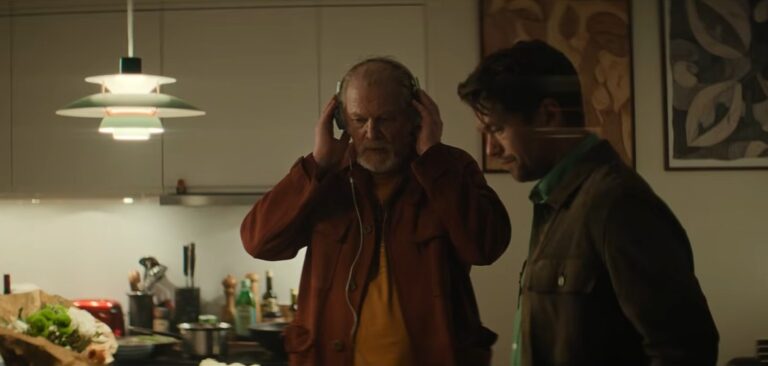
For anyone who hasn’t started the series yet, Blood Sacrifice follows police investigator Thomas Berg, played by Jakob Oftebro, after a disturbing case develops in the Stockholm archipelago.
Two police officers respond to a home invasion call at an isolated summer house. When they arrive, everything appears strangely normal. The situation changes dramatically when both officers are found brutally murdered the following day.
The killings become the starting point for a much larger investigation involving a serial killer targeting members of law enforcement.
Thomas quickly realizes that solving the case won’t be straightforward. Pressure builds from the police, the public and the wider law-enforcement community, leaving him increasingly desperate for answers.
That desperation brings him back into contact with his estranged father, Alfred Berg, portrayed by Peter Andersson.
And this is where the series becomes more than a conventional serial-killer procedural.
Thomas and Alfred have years of resentment between them. Alfred is a retired detective with a cynical view of the profession, while Thomas is still trying to prove himself in an increasingly brutal investigation. Their relationship gives the story a second mystery running underneath the murder case: can two people who barely know how to speak to each other actually work together when lives are at stake?
The supporting cast includes Electra Hallman, Alexander Abdallah, Irina Björklund, and Magnus Krepper, strengthening the police ensemble surrounding the investigation.
What Are Viewers Saying About Blood Sacrifice?
The reception has been mixed, which honestly feels more interesting than universal praise.
A lot of viewers have responded positively to the brisk pacing and the decision to use summer Stockholm as the backdrop. The series doesn’t spend much time wandering around simply because streaming dramas are often expected to fill eight or ten episodes.
At five episodes, Blood Sacrifice moves.
The performances from Oftebro and Andersson have also attracted attention, particularly when the story focuses on the uneasy relationship between Thomas and Alfred.
The criticism is mostly aimed at the structure. Some viewers feel the series is trying to handle two different stories at once: a violent serial-killer investigation and an emotionally heavy father-son drama.
I can understand that complaint.
There are moments when the crime plot feels like it needs to sprint while the character material wants to slow down. By the final episodes, that tension becomes more noticeable, and some of the emotional resolutions arrive faster than they probably should.
I’ve also seen the argument that Blood Sacrifice might have worked as a longer feature film. I’m not completely convinced, but I understand where that reaction comes from. The five-episode structure keeps things moving, yet it doesn’t always give every character beat enough breathing room.
Still, the atmosphere is difficult to dismiss.
Outlander Blood of My Blood Season 2 Filming Locations Scotland: Ultimate Guide
Is Blood Sacrifice Actually Worth Watching in 4K?
For me, this is less about whether you can technically see the difference between 1080p and 4K and more about the kind of viewer you are.
If you’re watching on a standard Full HD television with basic speakers, I wouldn’t upgrade Netflix purely for this series. You’ll still get the story, performances and atmosphere.
But if you’ve already invested in a 4K HDR television, particularly an OLED or a high-end LED set, Blood Sacrifice is a much better argument for using the Premium tier.
The summer setting gives HDR something meaningful to work with, while the darker crime scenes benefit from stronger contrast and shadow detail. Add Dolby Atmos to the equation and the series becomes a surprisingly good showcase for a modern home theater.
There is also the simple fact that Blood Sacrifice is only five episodes. The entire story was released at once, making it easy to watch over a couple of evenings rather than committing to a sprawling ten-hour season.
Blood Sacrifice Netflix 4K HDR: Final Verdict
Yes, Blood Sacrifice is available in 4K HDR on Netflix, with Dolby Vision and Dolby Atmos available for compatible Premium subscribers and equipment.
Whether it’s worth upgrading depends on your setup. If you’re already using a 4K HDR television and have decent internet, I’d absolutely watch it in the highest available quality. The combination of bright Scandinavian summer landscapes, grim interiors and disturbing crime scenes gives the HDR presentation something genuinely useful to do.
And that’s what I appreciate most about the visual approach. The show doesn’t need artificial spectacle to look good. Its strongest images come from the uncomfortable contrast between beautiful surroundings and an increasingly ugly investigation.
Blood Sacrifice isn’t a flawless crime thriller, and the compressed five-episode structure occasionally shows its seams. But visually, it has considerably more personality than the average streaming procedural.
If you have the Premium plan, a 4K HDR display and a stable 25 Mbps-or-better connection, there’s little reason not to watch it that way. For this particular series, the higher-quality stream isn’t just a number attached to the Netflix menu. It actually complements what the filmmakers are doing with light, shadow, color and sound.